

Identity area
Identifier
Authorized form of name
Parallel form(s) of name
- Superior Electoral Court
Other form(s) of name
Type
- National
Contact area
Type
Address
Street address
Locality
Region
Country name
Postal code
Telephone
Fax
Note
Type
Address
Street address
Locality
Region
Country name
Postal code
Telephone
Fax
URL
Note
Description area
History
The Tribunal Superior Eleitoral (Superior Electoral Court) was created on February 24, 1932, and installed on May 20 of the same year under the name of Tribunal Superior da Justiça Eleitoral (Superior Electoral Justice Court). It was presided over by Minister Hermenegildo Rodrigues de Barros. However, the Constitution granted in 1937 by Getúlio Vargas instituted the Estado Novo, abolished the Electoral Justice, and exclusively granted the Union the power to legislate on electoral matters for the Union, states, and municipalities. The Tribunal Superior Eleitoral was re-established, already with its current name, by Decree-Law No. 7,586 of May 28, 1945. It was installed under the presidency of Minister José Linhares at the Monroe Palace in Rio de Janeiro, where it operated until 1946. That year, the Court's headquarters were transferred to Rua 1º de Março in the same city. In April 1960, the TSE headquarters were relocated to Brasília due to the transfer of the federal capital. The Court's move to its headquarters at Praça dos Tribunais Superiores took place in 1972. On December 15, 2011, the current headquarters of this Court, located at Setor de Administração Federal Sul, was inaugurated.
Geographical and cultural context
Mandates/Sources of authority
Administrative structure
The Court is composed of seven ministers: three originate from the Supremo Tribunal Federal (Supreme Federal Court), two from the Superior Tribunal de Justiça (Superior Court of Justice), and two representatives of the class of jurists—lawyers with notable legal knowledge and integrity. Each minister is elected for a two-year term, with reappointment prohibited after two consecutive terms. The rotation of judges within the scope of Electoral Justice aims to maintain the apolitical nature of the courts, ensuring equality in elections. The T.S.E. is presided over by a minister originating from the Supremo Tribunal Federal (STF).
Records management and collecting policies
Buildings
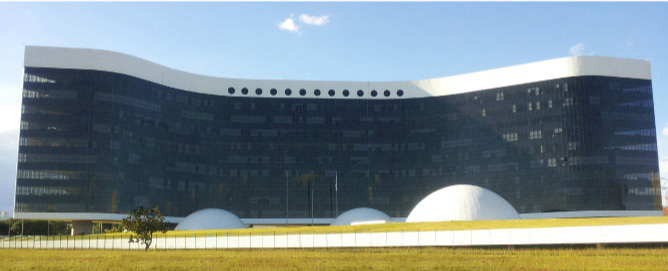
The Tribunal Superior Eleitoral's headquarters building is a project by Oscar Niemeyer, whose contract with the Court's administration was signed in 2005. In the same year, the cornerstone of the construction was laid, standing out for its modern architecture, sustainability, and accessibility, always closely monitored by the rigorous oversight of the ministers who presided over the TSE between 2005 and 2011. The vertiginous growth of the electorate over the last 40 years—from 30 million in 1971 to 136 million in 2011—made the old headquarters too small, and the TSE had to be divided between the main building and three annexes, which hindered the movement of processes and people. The Court's plenary, with only 63 seats, could no longer accommodate the audience for major trials and ceremonies, such as the President of the Republic's inauguration.
Holdings
It´s documentation began to be produced in 1932. During the period from 1937 to 1945, the Electoral Justice was abolished, and no documents were generated at that period. The Court's collection is managed by the Seção de Arquivo (Archives Section) and consists of judicial cases, administrative procedures, rulings, resolutions, ordinances, service orders, and other types of documents.
Finding aids, guides and publications
The Classification, Evaluation, and Allocation Plan for Information and Documents comprises: I – the Classification Plan for TSE's Information and Documents; II – the Evaluation and Allocation Plan for TSE's Information and Documents. The classification model used is ideological. It begins with the examination of the TSE archives's specificities and the proposition of ideas regarding their relationship with the institution’s historical-administrative trajectory. Activities and informational results were used as the main defining elements of series, subseries, and dossiers. The adopted model seeks to reflect the administrative and technical routine of the Court. Regarding coding, the block-numeric system was chosen. The plan’s architecture is open, allowing the inclusion of new intellectual filing units (series, subseries, and dossiers) at any time.
Access area
Opening times
12:00 pm to 7:00 pm, at working days (monday through Friday)
Access conditions and requirements
Accessibility
It´s headquarters were designed to serve all people with equality, security and confort, regardless of their physical limitations.
Services area
Research services
It´s collection is available in Portuguese and can be searched through the form: http://www.tse.jus.br/o-tse/sistemas/arquivo-do-tse-solicite-sua-pesquisa
Reproduction services
Public areas
Control area
Description identifier
Institution identifier
Rules and/or conventions used
Status
Level of detail
Dates of creation, revision and deletion
Language(s)
- Brazilian Portuguese